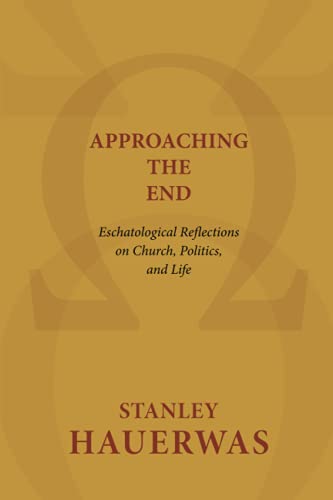
Approaching the end : eschatological reflections on church, politics, and life / Stanley Hauerwas.
Material type: TextPublication details: Grand Rapids, MI : William B. Eerdmans; 2013.Description: a xvii, 251 pages ; 23 cmISBN:
 - 9780802869593 (pbk. : alk. paper)
- 0802869599 (pbk. : alk. paper)
- 236 23
- BX4827.H34 A5 2013
 Books
Books
| Cover image | Item type | Current library | Home library | Collection | Shelving location | Call number | Materials specified | Vol info | URL | Copy number | Status | Notes | Date due | Barcode | Item holds | Item hold queue priority | Course reserves | |
|---|---|---|---|---|---|---|---|---|---|---|---|---|---|---|---|---|---|---|
| Judith Thomas Library General Stacks | Books | BX 4827 .H34 A5 2013 (Browse shelf(Opens below)) | AUA24205 | Available | AUA24205 | |||||||||||||
| Judith Thomas Library General Stacks | Books | BX 4827 .H34 A5 2013 (Browse shelf(Opens below)) | AUA24206 | 2 | Available | AUA24206 |
Includes bibliographical references and index.
Part I. Theological matters : -- The end is in the beginning : creation and apocalyptic -- The end of sacrifice : an apocalyptic politics -- Witness (with Charles Pinches) -- Part II. $t Church and politics : -- Church matters : on faith and politics -- The end of Protestantism -- Which church? What unity? or, An attempt to say what I may think about the future of Christian unity -- War and peace -- Part III. $t Life and death : -- Bearing reality -- Habit matters : the bodily character of the virtues -- Suffering presence : twenty-five years later -- Cloning the human body (with Joel Shuman) -- Doing nothing gallantly (with Gerald McKenny) -- Disability : an attempt to think with.
In this book Stanley Hauerwas explores the significance of eschatological reflection for helping the church negotiate the contemporary world. In Part One, "Theological Matters," Hauerwas directly addresses his understanding of the eschatological character of the Christian faith. In Part Two, "Church and Politics," he deals with the political reality of the church in light of the end, addressing such issues as the divided character of the church, the imperative of Christian unity, and the necessary practice of sacrifice. End, for Hauerwas, has a double meaning -- both chronological end and end in the sense of "aim" or "goal." In Part Three, "Life and Death," Hauerwas moves from theology and the church as a whole to focusing on how individual Christians should live in light of eschatology. What does an eschatological approach to life tell us about how to understand suffering, how to form habits of virtue, and how to die? -- Publisher